Find the Google Colab notebook for this example here.
Pharmacy Supply Chain
This study is from a publication 'Improving Simulation Optimization Run Time When Solving For Periodic Review Inventory Policies in A Pharmacy', read it here. This study uses the simulation-based optimization (SBO) method to find the optimum values of replenishment policy parameters (s, S) to minimize the overall cost of the pharmacy supply chain.
In this example, we aim to understand the supply chain network system described by the authors and to use SupplyNetPy to implement it and replicate the results. This exercise allows us to evaluate the complexity of reconstructing a specific system with SupplyNetPy and to validate the library.
System Description
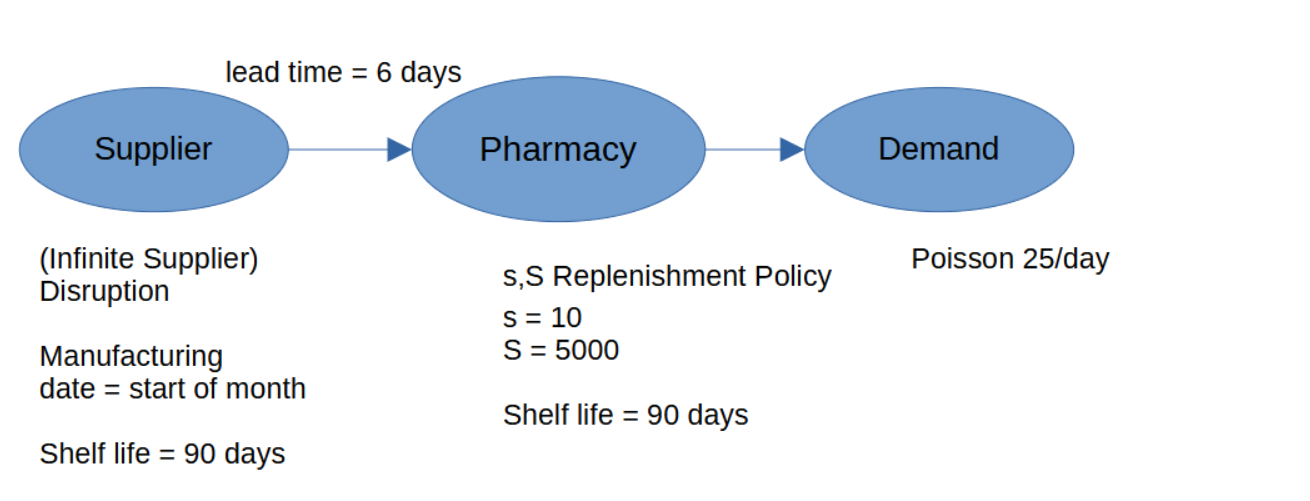
The system is a single-echelon supply chain — that is, a chain with just one layer between the source and the customer. In this case, a hospital pharmacy (the distributor) is supplied directly by a pharmaceutical manufacturing facility (the supplier).
- The pharmacy faces stochastic (i.e., unpredictable, day-to-day-varying) demand and is connected to a supplier with unlimited stock.
- On any given day, the supplier may be disrupted (unable to ship) with probability 0.001.
- The pharmacy follows an (s, S) replenishment policy: when the inventory level falls below s, place an order large enough to bring it up to S.
- The product is perishable, with a shelf life of 90 days.
- The authors model and simulate this system to find the values of s and S that minimize the expected total cost per day.
Inventory Type: Perishable
Inventory position is the amount of stock the pharmacy can count on as of today — what is physically on the shelf right now, plus anything already ordered that has not yet arrived (i.e., in transit from the supplier). It is the basis on which the next reorder decision is made.
Inventory position = inventory on hand + inventory en route
Replenishment Policy: (s, S) — when the inventory position falls below s, place an order for (S − current inventory position) units, so that the position is brought back up to S.
Review period = 1 day (the pharmacy checks its inventory every day).
The flowchart below uses the following shorthand:
H = inventory on hand (what is on the shelf)
H′ = portion of H that will expire at the end of day t
P = inventory position = H + inventory en route
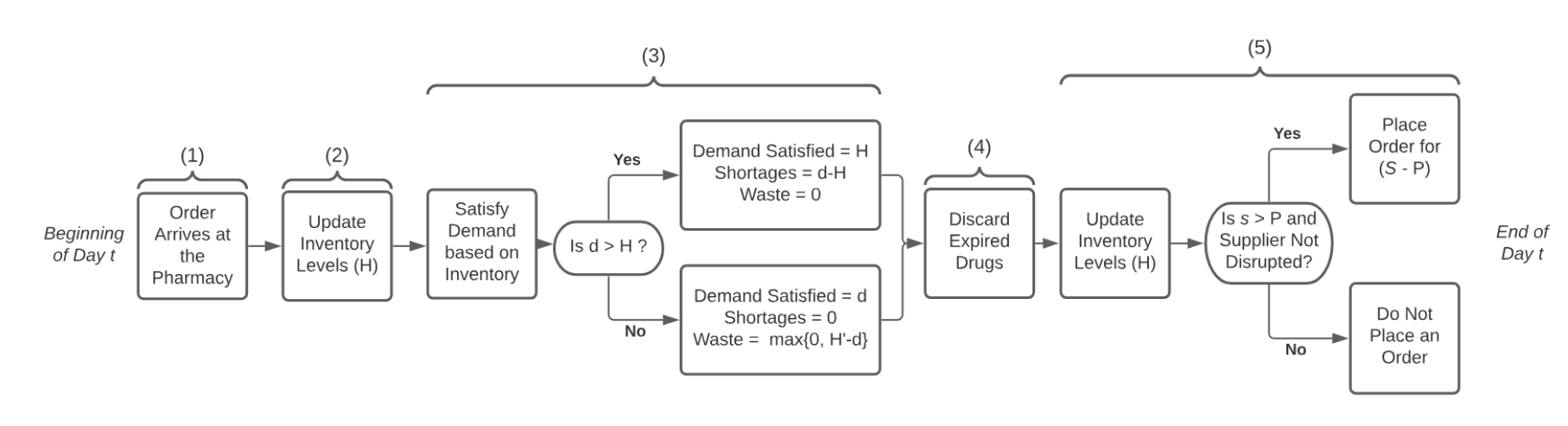
This flowchart illustrates the order and sequence of events that take place at the pharmacy.
(Image source)
Algorithm: Process flow of Perishable Inventory
Begin day t
    1. Order arrive at the Pharmacy
    2. Update Inventory Levels (H)
    3. Satisfy demand based on Inventory Levels
        3.1. If (d>H):
            - demand Satisfied = H
            - Shortage = d-H
            - Waste = 0
        3.2. Else:
            - demand Satisfied = d
            - Shortage = 0
            - Waste = max{0,H'-d}
    4. Discard Expired Drugs
    5. Update Inventory Levels (H)
        5.1. Is (s>P) and (Supplier not Disrupted):
            - Place order for (S-P)
        5.2. Else:
            - Do not place order
    6. End of the day t
Optimization Objective: Minimize Expected Cost per day
Costs of interest are shortage, waste, holding and ordering
Assumptions
- All drugs that arrive in the same month come from the same production batch and have same end of the month expiration date. Hence drugs are only discarded at the end of the month.
- The inventory on-hand is know each day.
- Estimated days until inventory expires is known each day.
- Lead time is deterministic and positive. The order placed at the end of the day (t-1) arrives at the beginning of day t.
- Demand is stochastic.
- Supply uncertainty is due to disruptions (these two are independent of each other)
- All demand that is not met is lost.
- First in first out protocol is followed when serving orders.
System Configuration
- T = number of days (360 days)
- l = deterministic lead time (6 days)
- e = shelf life of the drugs (months) (3 months)
- R = number of simulation replication (5000)
- b = shortage cost (5 units)
- z = waste cost (1 units)
- h = holding cost (0.001 units)
- o = ordering cost (0.5 units)
- dt = demand on day t (stochastic) (Poisson 25/day)
- yt = binary variable for supply disruption status on day t (yt=0 disrupted, yt=1 available) (stochastic) (p=0.01)
- disrupt_time ~ Geom(p=0.01)
- recovery_time ~ Geom(p=1/30)
Implementation
import simpy
import numpy as np
import matplotlib.pyplot as plt
from matplotlib.pyplot import figure
import SupplyNetPy.Components as scm
class Distributions:
    """
    Class to generate random numbers for demand (order quantity) and order arrival arrival times.
    Parameters:
        mu (float): Mean of the exponential distribution for order arrival times.
        lam (float): Lambda parameter of the Poisson distribution for demand (order quantity).
    """
    def __init__(self,mu=1,lam=1,p=0.01):
        self.mu = mu
        self.lam = lam
        self.p = p

    def poisson_demand(self):
        return np.random.poisson(self.lam)

    def expo_arrival(self):
        return np.random.exponential(self.mu)

    def geometric(self):
        return np.random.geometric(self.p,1)[0]

def manufacturer_date_cal(time_now):
    """Calculate manufacturing date rounded down to the nearest month."""
    return time_now - (time_now % 30)

# Global parameters
T = 360     #number of days (360 days)
l = 6       #deterministic lead time (6 days)
e = 90      #shelf life of the drugs (months) (3 months)
R = 5000    #number of simulation replication (5000)
b = 5       #shortage cost (5 units)
z = 1       #waste cost (1 units)
h = 0.001   #holding cost (0.001 units)
o = 0.5     #ordering cost (0.5 units)
dt = 25     #demand on day t (stochastic) (Poisson 25/day)
# yt = binary variable for supply disruption status on day t (yt=0 disrupted, yt=1 available) (stochastic) (p=0.01)
yt_p = 0.01  # ~ Geometric(p=0.01), sampled from Geometric distribution with probability p = 0.01
yt_r = 1/30 # node recovery time ~ Geometric(p=1/30), sampled from Geometric distribution with probability p = 1/30 = 0.033
price = 7 # unit cost of drug

def setup_simulation(env, s, S, ini_level, st, disrupt_time, recovery_time):
    """Setup environment, supplier, distributor, link, and demand process."""
    supplier = scm.Supplier(env=env, ID="S1", name="Supplier 1", node_type="infinite_supplier",
                            node_disrupt_time=disrupt_time.geometric,
                            node_recovery_time=recovery_time.geometric)

    distributor = scm.InventoryNode(env=env, ID="D1", name="Distributor 1", node_type="distributor",
                                    capacity=float('inf'), initial_level=ini_level,
                                    inventory_holding_cost=h, inventory_type="perishable",
                                    manufacture_date=manufacturer_date_cal, shelf_life=e,
                                    replenishment_policy=scm.SSReplenishment,
                                    policy_param={'s': s, 'S': S},
                                    product_buy_price=0, product_sell_price=price)

    link = scm.Link(env=env, ID="l1", source=supplier, sink=distributor,
                    cost=o, lead_time=lambda: l)

    demand = scm.Demand(env=env, ID="d1", name="demand 1", order_arrival_model=lambda: 1,
                        order_quantity_model=st.poisson_demand, demand_node=distributor)

    return supplier, distributor, demand, link

def single_sim_run(S, s, ini_level, logging=True):
    """Run a single simulation instance and return expected cost."""
    env = simpy.Environment()
    st = Distributions(mu=1, lam=dt)
    disrupt_time = Distributions(p=yt_p)
    recovery_time = Distributions(p=yt_r)

    supplier, distributor, demand, link = setup_simulation(env, s, S, ini_level, st, disrupt_time, recovery_time)

    pharma_chain = scm.create_sc_net(env=env, nodes=[supplier, distributor], links=[link], demands=[demand])
    pharma_chain = scm.simulate_sc_net(pharma_chain,sim_time=30,logging=logging)
    supplier.stats.reset()
    distributor.stats.reset()
    demand.stats.reset()
    pharma_chain = scm.simulate_sc_net(pharma_chain,sim_time=T,logging=logging)

    shortage = distributor.stats.shortage[1]
    waste = distributor.stats.inventory_waste
    holding = distributor.stats.inventory_carry_cost
    transport = distributor.stats.transportation_cost

    total_cost = (shortage * b + waste * z + holding + transport)
    norm_cost = total_cost / ((T - 30) * (b + z + h + o)) * price

    if logging:
        print("Shortage cost:", shortage * b)
        print("Waste cost:", waste * z)
        print("Holding cost:", holding)
        print("Transportation cost:", transport)

    return norm_cost

def run_for_s(s_low, s_high, s_step, capacity, ini_level, num_replications):
    """Run simulations across reorder point values and report results."""
    results = []
    st = Distributions(mu=1, lam=dt)
    disrupt_time = Distributions(p=yt_p)
    recovery_time = Distributions(p=yt_r)


    #print("reorder_point, exp_cost_per_day, std, std_err")
    for s in range(s_low, s_high, s_step):
        costs = []
        for _ in range(num_replications):
            env = simpy.Environment()
            supplier, distributor, demand, link = setup_simulation(env, s, capacity, ini_level, st, disrupt_time, recovery_time)

            pharma_chain = scm.create_sc_net(env=env, nodes=[supplier, distributor], links=[link], demands=[demand])
            pharma_chain = scm.simulate_sc_net(pharma_chain,sim_time=30,logging=False)
            supplier.stats.reset()
            distributor.stats.reset()
            demand.stats.reset()
            pharma_chain = scm.simulate_sc_net(pharma_chain,sim_time=T,logging=False)

            shortage = distributor.stats.shortage[1]
            waste = distributor.stats.inventory_waste
            holding = distributor.stats.inventory_carry_cost
            transport = distributor.stats.transportation_cost

            total_cost = (shortage * b + waste * z + holding + transport)
            norm_cost = total_cost / ((T - 30) * (b + z + h + o)) * price
            costs.append(norm_cost)

        mean_cost = np.mean(costs)
        std_dev = np.std(costs)
        std_err = std_dev / np.sqrt(num_replications)

        #print(f"[{s}, {mean_cost}, {std_dev}, {std_err}]")
        results.append((s, mean_cost, std_dev, std_err))

    return results
# Parameters for the simulation
s_low = 100
s_high = 5000
s_step = 100
capacity = 5000
ini_level = 5000
num_rep = 1000
Assessing Time Complexity
First, let's evaluate the time complexity in relation to the number of simulation runs (replications) (R) in order to estimate the expected costs. The code estimates the execution time for R simulations, where R takes on the values of 1000, 2000, 3000, 4000, and 5000.
import time
stats = []
scm.global_logger.disable_logging() # enable logging
for replications in [1000, 2000, 3000, 4000, 5000]:
    exp_cost_arr = []
    start_time = time.time()
    for rep in range(0, replications):
        exp_cost_arr.append(single_sim_run(s=2000,S=5000,ini_level=5000,logging=False))
    exp_cost_arr = np.array(exp_cost_arr)
    exe_time = time.time() - start_time
    print(f"R ={replications}, exe_time:{exe_time} sec, mean:{np.mean(exp_cost_arr)}, std:{np.std(exp_cost_arr)}, std_err:{np.std(exp_cost_arr)/np.sqrt(R)}")
    stats.append((replications, exe_time, np.mean(exp_cost_arr), np.std(exp_cost_arr), np.std(exp_cost_arr)/np.sqrt(replications)))
R =1000, exe_time:22.119476795196533 sec, mean:51.75029532053344, std:23.668711396825312, std_err:0.33472612661285
R =2000, exe_time:45.451146602630615 sec, mean:51.80183997566808, std:23.633314688276155, std_err:0.33422554155991413
R =3000, exe_time:68.95947742462158 sec, mean:51.01044921449537, std:23.62288667057547, std_err:0.3340780671193043
R =4000, exe_time:86.83561849594116 sec, mean:51.584926030610674, std:23.706247962166834, std_err:0.3352569738107588
R =5000, exe_time:106.06455659866333 sec, mean:52.27106894743466, std:23.863645906143574, std_err:0.3374829168813743
Estimating Confidence Interval
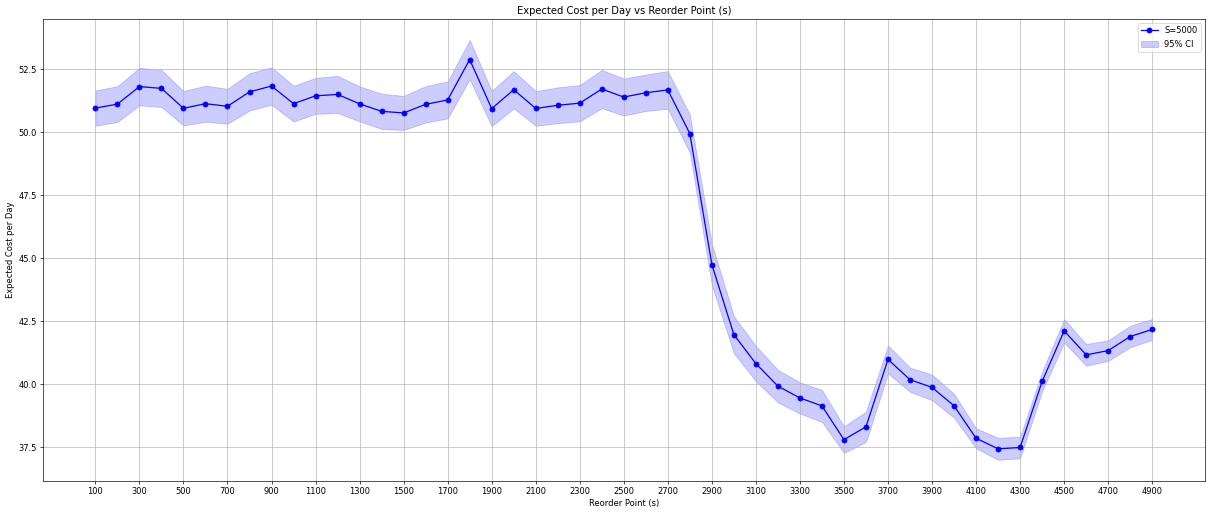
To ensure the estimation error is reasonable, we estimate the expected costs for the replenishment policy setting \(S = 5000\) and variable \(s\) with \(R = 1000\) simulation runs and plot the confidence intervals.
exp_cost_per_day = run_for_s(s_low=s_low,s_high=s_high,s_step=s_step,capacity=capacity,ini_level=ini_level,num_replications=num_rep)
exp_cost_per_day = np.array(exp_cost_per_day)

figure(figsize=(25, 10), dpi=60)
plt.plot(exp_cost_per_day[:,0], exp_cost_per_day[:,1],marker='o', linestyle='-', color='b', label='S=5000')
plt.fill_between(exp_cost_per_day[:,0], exp_cost_per_day[:,1]-2*exp_cost_per_day[:,3], exp_cost_per_day[:,1]+2*exp_cost_per_day[:,3],alpha=0.2, color='b', label='95% CI')
plt.xlabel('Reorder Point (s)')
plt.ylabel('Expected Cost per Day')
plt.xticks(np.arange(s_low, s_high, 200))
plt.title('Expected Cost per Day vs Reorder Point (s)')
plt.legend()
plt.grid()
plt.show()
Running the Model with Varying (S, s)
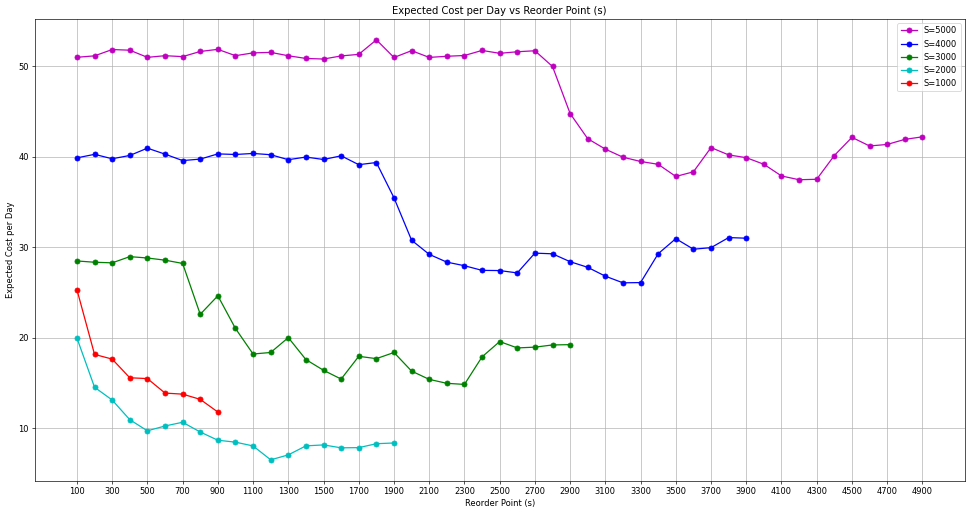
To determine the optimal values of the parameters \(S\) and \(s\), we run the model with different settings for both parameters. The parameter \(S\) takes on values of 1000, 2000, 3000, 4000, and 5000. For each value of \(S\), the parameter \(s\) is set to values ranging from 100 up to \(S\). The results obtained from these runs are then plotted and compared with the findings reported by the authors. Below, we present both sets of plots for comparison.
exp_cost_per_day = run_for_s(s_low=s_low, s_high=5000, s_step=s_step, capacity=5000, ini_level=5000, num_replications=num_rep)
exp_cost_per_day = np.array(exp_cost_per_day)

exp_cost_per_day2 = run_for_s(s_low=s_low,s_high=4000,s_step=s_step,capacity=4000,ini_level=4000,num_replications=num_rep)
exp_cost_per_day2 = np.array(exp_cost_per_day2)

exp_cost_per_day3 = run_for_s(s_low=s_low,s_high=3000,s_step=s_step,capacity=3000,ini_level=3000,num_replications=num_rep)
exp_cost_per_day3 = np.array(exp_cost_per_day3)

exp_cost_per_day4 = run_for_s(s_low=s_low,s_high=2000,s_step=s_step,capacity=2000,ini_level=2000,num_replications=num_rep)
exp_cost_per_day4 = np.array(exp_cost_per_day4)

exp_cost_per_day5 = run_for_s(s_low=s_low,s_high=1000,s_step=s_step,capacity=1000,ini_level=1000,num_replications=num_rep)
exp_cost_per_day5 = np.array(exp_cost_per_day5)

figure(figsize=(25, 10), dpi=60)
plt.plot(exp_cost_per_day[:,0], exp_cost_per_day[:,1],marker='o', linestyle='-', color='m', label='S=5000')
plt.plot(exp_cost_per_day2[:,0], exp_cost_per_day2[:,1],marker='o', linestyle='-', color='b', label='S=4000')
plt.plot(exp_cost_per_day3[:,0], exp_cost_per_day3[:,1],marker='o', linestyle='-', color='g', label='S=3000')
plt.plot(exp_cost_per_day4[:,0], exp_cost_per_day4[:,1],marker='o', linestyle='-', color='c', label='S=2000')
plt.plot(exp_cost_per_day5[:,0], exp_cost_per_day5[:,1],marker='o', linestyle='-', color='r', label='S=1000')
plt.xticks(np.arange(s_low, s_high, 200))
plt.xlabel('Reorder Point (s)')
plt.ylabel('Expected Cost per Day')
plt.title('Expected Cost per Day vs Reorder Point (s)')
plt.legend()
plt.grid()
plt.show()
The following plot displays the results obtained by the authors.
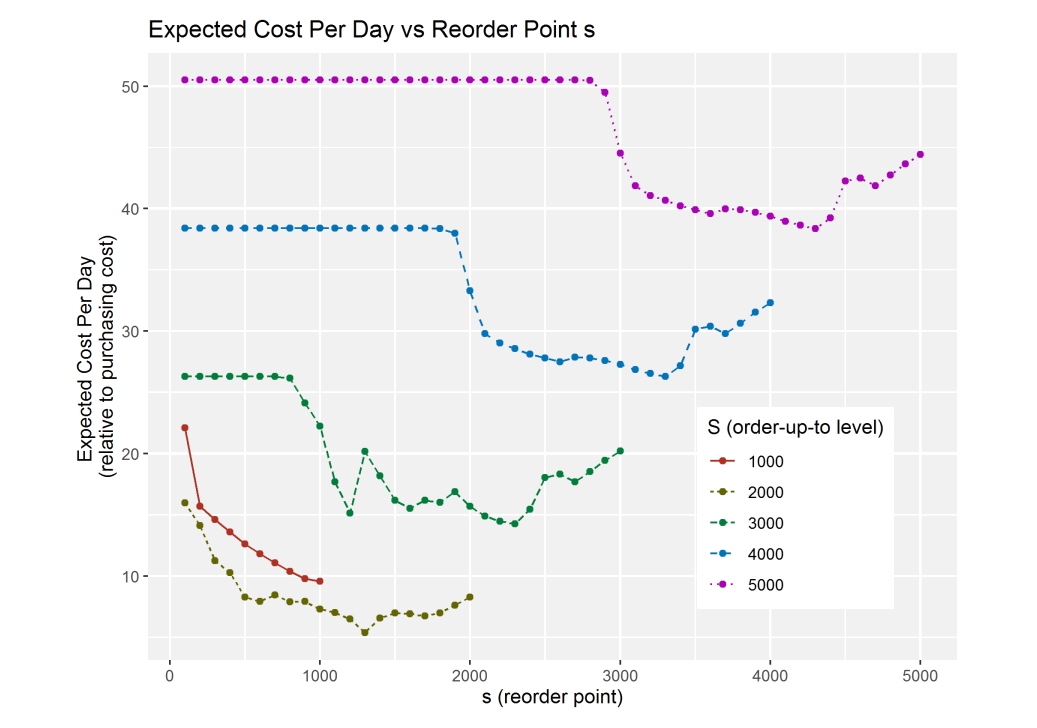
Image source: link.